- Monday - Sunday 24/7 Hours Support
- +8615517160690

Maintaining strict temperature stability in a -196°C liquid nitrogen (LN2) ultra-low temperature freezer is crucial for preserving high-value biological assets such as CAR-T cell therapy, stem cells, vaccines, and clinical trial samples. However, relying solely on the built-in single-point temperature monitoring of the equipment not only presents significant temperature blind spots but also fails to meet the stringent FDA and GMP compliance requirements of the biomedical industry. Therefore, laboratories must conduct scientific thermal mapping. Adopting a GMP-compliant wireless thermal mapping solution not only fully ensures the stability and audit compliance of sample storage but also eliminates the need for management personnel to open the lid or connect to a computer. They can simply approach the equipment and read data in real time via a mobile app, significantly reducing the risk of temperature fluctuations caused by opening the lid.
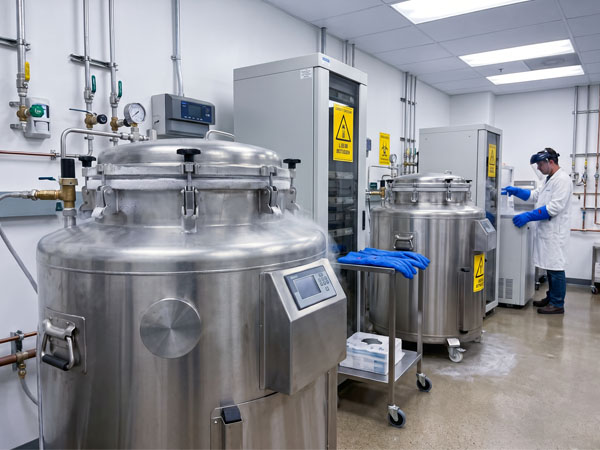
-196°C liquid nitrogen (LN2) belongs to an extremely cold environment, and the core purpose of thermal mapping is to comprehensively evaluate the temperature uniformity of the storage space through high-density multi-point deployment, ensuring that it meets the stringent preservation requirements of high-value biological products. Ordinary temperature recorders are prone to battery failure or damage in such extreme cold, so it is necessary to use professional equipment specifically designed for deep-cold environments.
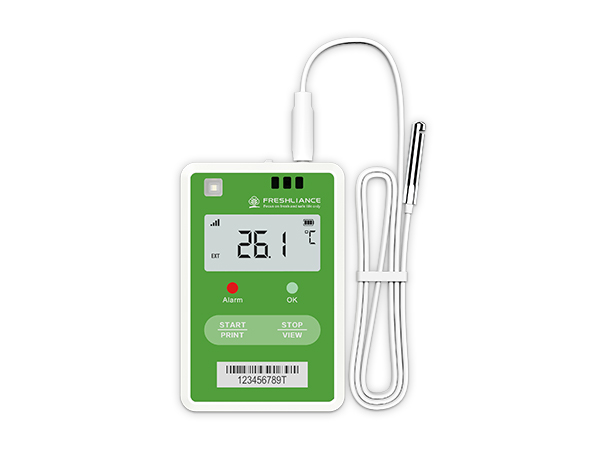
The BlueTag TH30R-ETU Bluetooth temperature data logger, launched by Freshliance, can accurately monitor temperatures as low as -196°C by pairing with an ultra-low temperature external probe. It maintains high measurement accuracy of ±1.0°C in deep-cold environments and is fully capable of performing temperature field verification tasks in liquid nitrogen ultra-low temperature freezers. Addressing the common concern among enterprises about the potential damage to tank lid sealing caused by external probes, Freshliance specifically provides a Flexible Ultra-Thin Cable. This cable not only fits tightly with the sealing ring, preventing cold leakage and frosting, but also supports customization of various cable lengths, allowing for flexible wiring and easy access to the gas or liquid phase areas at the bottom of large liquid nitrogen tanks.
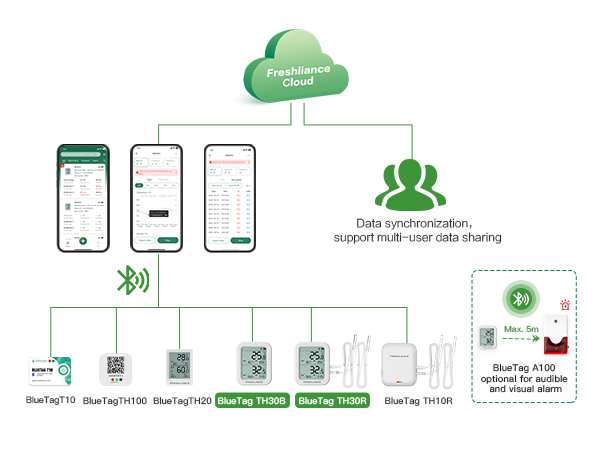
Compared to traditional wired solutions, the biggest advantage of this wireless thermal mapping lies in its “no need to open the cover or connect to a computer” feature. Managers can simply approach the device and remotely configure parameters and view real-time and historical temperature curves through the Tkeeper App (supporting iOS/Android), significantly improving work efficiency while avoiding temperature fluctuations caused by opening the cover. In terms of compliance, the BlueTag TH30R-ETU Bluetooth temperature data logger fully meets the GMP wireless temperature verification standards: the single probe has 20,000 sets of non-volatile local storage and supports 2 years of free cloud storage; the software can export tamper-proof PDF/CSV audit reports at any time and supports customizable high and low temperature alarm thresholds. Once a temperature deviation occurs during the mapping period, an alarm is immediately triggered, perfectly meeting GMP’s requirements for timely response to deviation management.
The verification of ultra-low temperature distribution poses a high threshold for equipment’s extreme cold tolerance, network-disconnected zero-data-loss storage, ISO 17025 calibration traceability, and software systems compliant with FDA 21 CFR Part 11 regulations. Leveraging the dual advantages of hardware and software, Freshliance BlueTag TH30R-ETU Bluetooth temperature data logger provides a cost-effective, one-stop wireless thermal mapping solution for -196°C liquid nitrogen ultra-low temperature freezers, widely applicable to scientific research laboratories, hospitals, blood banks, assisted reproduction centers (IVF), cold chain warehousing, and biopharmaceutical enterprises.